

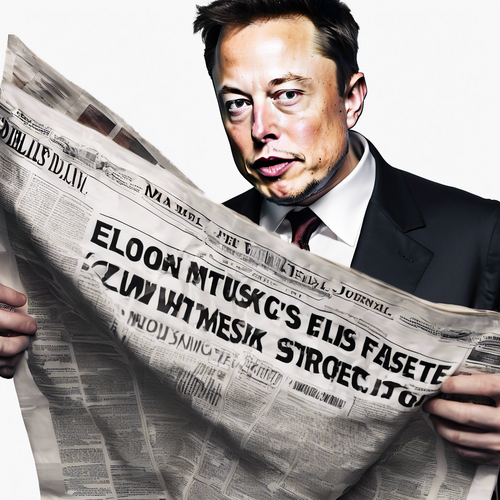
Elon Musk Berates Wall Street Journal for ‘Deliberately False Article’ Regarding Tesla’s Future
In a spectacular display of assertiveness, Elon Musk has lashed out at the Wall Street Journal (WSJ), labeling its recent article about his future with Tesla as ‘deliberately false.’ 🚗💥 This episode illuminates the contentious interplay between high-profile entrepreneurs and the media landscape, raising pivotal questions about journalistic integrity and the accuracy of reporting on influential figures in the tech industry.
With over 400 million followers on Twitter, Musk’s social media presence is a powerful tool that ensures his messages resonate widely. His accusations against the WSJ point to an alarming trend in financial journalism: the potential for sensationalism over fact, particularly when it concerns controversial figures like Musk. The article in question claimed to have insider knowledge on Musk’s alleged intentions regarding the electric vehicle giant, a report Musk categorically denied, asserting it lacked any semblance of truth. 📰❌
A Closer Look at the Article
According to Musk, the WSJ piece misrepresented significant facts regarding Tesla’s strategic plans. While details of the actual content have been kept closely guarded, analysts within the industry have speculated that the article may have amplified unfounded rumors about Musk’s potential departure or a shift in leadership at Tesla. Such narratives, Musk claims, are not just misleading but potentially damaging to Tesla’s stock and investor confidence. 📉⚠️
“The media has a responsibility to present facts, not fiction. If they don’t, it breeds mistrust and animosity towards legitimate journalism,” Musk said, reflecting a sentiment echoed by many in the tech world.
The Stakes: More than Just Reputation
The fallout from such reports extends beyond mere reputation. For Tesla, a company valued at over $800 billion, swings in public perception can directly affect its stock price and subsequently influence market stability. In an industry that thrives on innovation and investor confidence, maintaining credibility is paramount. 🚀📊
Musk’s scathing response highlights a broader issue within media circles—journalistic accountability. As reports about tech moguls proliferate, questions arise: How can outlets ensure they are reporting responsibly? What checks are in place to prevent the dissemination of misleading narratives?
The Media’s Role and Responsibilities
In an age where information spreads at lightning speed, the media’s role is increasingly scrutinized. Musk’s allegations serve as a stark reminder that irresponsible journalism can lead to significant repercussions—from investor panic to reputational damage for companies and individuals alike.
The WSJ, a long-established entity in business reporting, is not immune to criticism. Its track record has included both groundbreaking journalism and instances of perceived bias. As media consumers become more discerning, outlets like the WSJ must navigate the fine line between engaging storytelling and factual accuracy.
What’s Next for Musk and Tesla?
While the immediate controversy may seem like a tempest in a teapot, it underscores a pattern that could have long-lasting effects. Musk’s relationship with the media is complex and often tempestuous, marked by rapid responses to perceived slights and an unwavering commitment to setting the narrative. This incident not only puts the WSJ under a microscope but also serves as a call to action for all media to recommit to journalistic standards that prioritize fact over sensationalism. ⚖️
As Tesla continues to expand globally and innovate in energy solutions, Musk’s future decision-making will undoubtedly be influenced by the reputational landscape shaped by media narratives. This incident acts as a reminder to all stakeholders—journalists, entrepreneurs, and consumers—that the guardians of truth hold the keys to the marketplace of ideas.

I think Musk has a point, media should be more responsible! But hey, controversy sells, right? Whats your take?
Do we trust media blindly? Musk vs. WSJ drama raises questions. Are we critical enough? Share your thoughts! 🤔📰 #MediaResponsibility
I think Elon Musk has a point about media responsibility, but lets also consider the power of fact-checking and balanced reporting.
Is Elon Musk overreacting or holding media accountable? Its a fine line between scrutiny and sensationalism. Whats your take?