

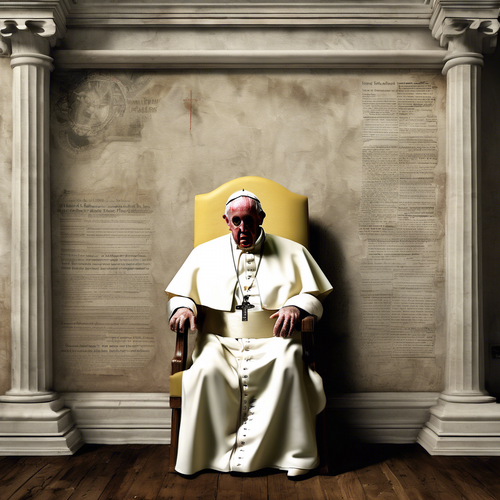
Papal Reflections: The Wall Street Journal’s Unexpected Critique of America’s First Pope
Lorem Ipsum dolor sit amet! The recent editorial penned by the Wall Street Journal directed at Pope Francis, the first American pontiff, has ruffled feathers across both religious and secular circles. The invocation of such a critical tone raises questions about the role of media in religious discourse and the nature of cultural expectations surrounding leadership. The WSJ’s rebuttal, unexpectedly abrasive, resonates with longstanding tensions between traditionalist views and modern interpretations of faith. 🕊️
This critique is not just another case of editorial discontent; it unveils broader societal reflections on the authority and direction of the Catholic Church under Pope Francis. With the unique context of Francis’s background—born Jorge Mario Bergoglio in Buenos Aires, Argentina, and later ascending to the papacy in 2013—his leadership has always straddled a cultural juncture between the global North and South. But can we truly evaluate his papacy through Western lenses alone? 📜
Contextualizing the Critique
Understanding the implications of the Wall Street Journal’s assertion requires a look back at the Pope’s previous actions and stances, which often traverse the complexities of contemporary issues such as immigration, climate change, and economic inequality.
- Immigration Advocacy: Francis has consistently advocated for the rights of migrants, calling attention to their plight at the US-Mexico border. This position puts him at odds with certain segments of the American political landscape, making his papal authority a topic of contention.
- Climate Advocacy: In his encyclical “Laudato Si’”, he emphasizes environmental stewardship, challenging consumerist paradigms that dominate Western economics. Such a stance, while embraced by many, meets fierce opposition from industries resistant to change. 🌎
- Wealth Disparity: His positions resonate with progressive factions globally but provoke a backlash from conservative factions who view wealth accumulation through a dogmatic lens. The WSJ’s criticism echoes this divide, questioning his judiciousness on page after page. 💰
The Power of Words: A Lesson in Media Influence
The commentary’s potent language is not merely an isolated instance; it reflects a calculated choice by the editorial board to assert influence over public perception. Words wield power, and in this case, they cast shadows over a figure who is already navigating a labyrinth of divided expectations.
“Language shapes not only our thoughts but our identities in this era of cultural polarization,” observes media analyst Dr. Timothy Carter. “The WSJ’s approach can galvanize support or sow further discord. The stakes are significant.”
Responses: From Outrage to Solidarity
The backlash against the Wall Street Journal’s publisher was swift, with many observers labeling the editorial as not only an affront to the Pope but also a dismissal of the values he embodies. Leaders from various faith communities voiced their support on social media, arguing that constructive dialogue is essential, as opposed to mere criticism.
- Bishop Frank J. Caggiano: “Pope Francis reflects the Gospel’s truth. Critique can enlighten, but derision stagnates growth.”
- Father James Martin: “This critique represents a failure to engage with the inclusivity and compassion central to Francis’s mission.”
Looking Forward: The Future of Papacy and Media Dynamics
The dialogue surrounding the first American pope represents a turbulent chapter in the broader narrative of religious leadership in the modern age. Is this the beginning of a cynical, adversarial relationship between mainstream media and the Catholic Church, or can it serve as an opportunity for constructive engagement on both fronts? The stakes are high as religious institutions reevaluate their roles amidst evolving socio-political landscapes. 🤔
“In the midst of dissent lies the potential for evolution. Faith is not stagnant; it is an unfolding story, and the media plays a critical role in how that story is told,” concludes Dr. Anna Morales, a scholar of religion and media studies.
As we reflect on the Wall Street Journal’s words, it remains evident that both the pontiff and the media are walking a tightrope. How they navigate this relationship will shape the narrative of faith and influence for generations to come. 🌟

Wow, the clash between Pope Francis and the Wall Street Journal is intense! Who do you think makes a stronger case? #MediaShowdown
Wow, the clash between Pope Francis and the Wall Street Journal is intense! Who do you think made a stronger argument? #MediaShowdown
I cant believe the drama between Pope Francis and Wall Street Journal! Who wouldve thought words could cause such a frenzy?
Wow, the clash between Pope Francis and Wall Street Journal is intense! Who do you think is right in this media showdown? Lets discuss!