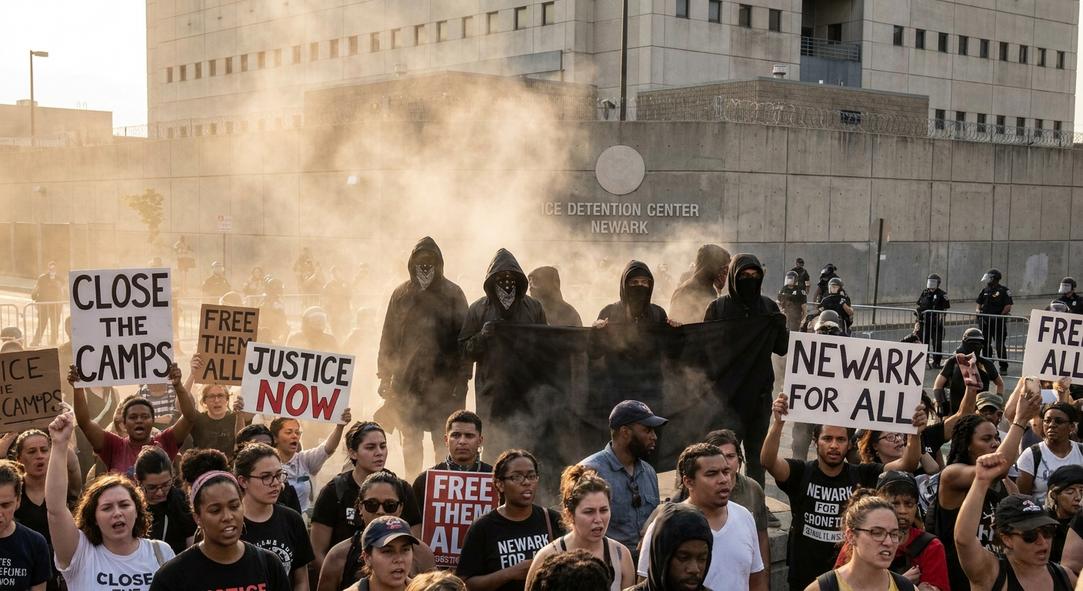
Out-of-State Agitators: Whodunit in the Land of Liberty and Protests? 🚓🗽
The Garden State, a place where American independence was once fiercely debated, now debates another type of incursion—one not on its shores, but amidst its cries for justice. Governor Phil Murphy of New Jersey has pointed an accusative finger at out-of-state agitators, suggesting they were fervently fanning the flames of protest outside the ICE detention center in Newark. One might ask: in the theater of democracy, who scripts the role of antagonist? 🎭
Picture this: a peaceful protest, as familiar and sure as the tide, turns turbulent under the shadow of unseen hands. It sounds almost mythological, like attributing a storm at sea to the wrath of ancient gods. Yet, in the simmering heat of political tension, claims of external meddling carry the weight of both plausibility and suspicion. On one hand, cross-state activist networks have undoubtedly aligned their purpose with strategic precision. On the other, painting agitators as intruders allows local administrations to deflect blame like rain off a slick raincoat. 🌧️
The Tale of Two Narratives
Strike a balance between the official narrative and the ground realities, and you realize how deftly lines blur. On the streets of Newark, protestors clamor for change. They decry the detention policies as unjust relics of an authoritarian past, their voices echoing as endlessly as waves crashing against a stubborn shore. Meanwhile, Murphy’s narrative of outsiders takes the spotlight, drawing parallels with historical yarns spun to divert attention from internal strife. The antithesis here is stark: protest as a cry for justice versus politics as the theater of survival.
A New Jersey Classic: The Blame Game 🎲
Murphy’s insinuations tap into a long-standing tactic: the classic whodunit game of political theater. It is as if the specter of Eugene V. Debs, that hoary agitator and master of dissent, hangs over our modern-day assemblies, whispering sweet accusations to suit myriad agendas. Yet, consider this: do external agitators merely stoke pre-existing embers, or are they responsible for lighting the pyre? A rhetorical twist that demands reflection rather than an immediate conclusion.
Behind the Veil: The Agitator’s Identity 👥
In examining these protests, it becomes pertinent to probe—what defines out-of-state agitation in the age of instantaneous information? How does the geographical demarcation blur when social media threads coil around issues tighter than steel? Anonymity, the hooded cloak of both the noble and the nefarious, casts shadows on the origins of participant endeavors.
Protest and Politics: The Inevitability of Collision
The Newark tensions are symptomatic of a broader dissonance—a friction between institutional power and grassroots movements. ICE detention protests are not isolated tempests but part of a broader atmospheric disturbance sweeping the nation. The formula seems predictable, like weather patterns: political rhetoric ← community discontent ↔ protest escalation.
“We see their influence, though often it’s as imperceptible as the wind,” remarked a local activist. “Yet, the winds themselves are made of voices—voices from both near and afar, blending into a collective cry.”
Murphy’s invocation of external agitators, possibly a refrain aimed at rallying local solidarity, may also subtly acknowledge the underlying unease within his own jurisdiction. After all, is it not more politically palatable to call out external forces, rather than confronting the discontent brewing in one’s own backyard? 🏡
Conclusion: A Call for Introspection
Ultimately, the challenge lies in sifting truth from conjecture, context from soundbyte. Allegations of out-of-state instigation might scintillate in headlines but unravel upon deeper scrutiny—highlighting not the arrival of an outside force, but the enduring presence of unresolved issues. As protests continue to unfold on the national stage, we are reminded of the enduring struggle between power and populace, contrast and consensus—a narrative as old as the nation itself, ever inviting us to question more deeply. 🎥🤔